|
|
10218 views
|
|
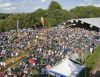
Event as seen from the lighting tower10146 views
|
|

Eddi Reader10036 views
|
|
Emmanuel College Westmorland Building10034 viewsEmmanuel College Westmorland Building
|
|

Eddi Reader10022 views
|
|
9814 views
|
|
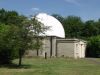
The Northumberland Equatorial Telescope, University Observatory, 18389797 views`The Northumberland' is the only remaining large instrument from the early days of the University Observatory, and is preserved because of its great historical interest. It was for some years one of the world's largest refracting telescopes with an accurate clock-driven equatorial mounting to follow a star in its diurnal motion across the sky.
The Duke of Northumberland, later Chancellor of the University, indicated his wish to present a large telescope to the recently founded Observatory in 1833, and was enthusiastically encouraged by the Director, G.B. Airy.
The lens was an achromatic doublet of 11.6 inches clear aperture and focal length 19ft 6in, made by Cauchoix of Paris. Airy recognised that the mounting needed to be of great rigidity and adopted the `English' form (of which the telescope is indeed one of the prototypes). The polar axis is composed of two massive triangular prisms of ingenious design, in which the components are kept in permanent tension and compression to attain the desired resistance to torsion and flexure.
The main structure was built by the engineers Ransomes of Ipswich, and the fine mechanical work by the London instrument makers Troughton and Simms. The polar axis frame and the telescope tube are of Norwegian fir. The observing chair which gives access to the eyepiece in all positions is the original. The polar axis points upwards to the North celestial pole, at an altitude equal to the latitude of the Observatory (+52degrees 13minutes). A small electric motor, now replacing the original mechanical clock, turns the polar axis once in a sidereal day. Once directed to a star the telescope tube remains in a fixed orientation in space, while the Earth turns beneath it.
A program of automation was started at the end of 2001 to provide high-precision coordinate capability.
The original Cauchoix lens is not (by present day optical standards) very good and it is now in store. The optics on the telescope are modern: a 12 inch aperture visual achromatic doublet designed by Dr R.V. Willstrop of the Institute and constructed by the local firm A.E. Optics Ltd. was installed to mark the 150th anniversary of the telescope.
The steel dome covering the telescope was made by Cooke, Troughton and Simms Ltd. of London & York in 1932 to replace the original wood structure which had become increasingly dilapidated after 96 years.
The telescope was last used in a regular Observatory research programme, for the micrometrical measurement of double stars, in the 1930s. It continues, however, to be actively used for visual observations by members of the University Astronomical Society (founded 1942) who have an Observing Guide on the CUAS website, and for Public Observing on clear Wednesday evenings in the winter months, and so continues a useful life of now over 150 years.
Description source: Institute of Astronomy
|
|

Church9754 viewsAnyone know the name of this church?
|
|
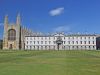
King's College Chapel and Gibbs' Building9397 viewsGibbs' building, begun in 1724 and named after its architect. The building was part of a more elaborate scheme which was to include two more similar buildings on the south and east sides of the front court.
|
|

House with a garden9342 views
|
|

Eddi Reader9329 views
|
|

Richard Thompson9213 views
|
|
| 125 files on 11 page(s) |
 |
|
|
5 | |
|
|
|
|
|